
‘An ecological crisis with consequences we're only beginning to understand'
Interview with Bolivian journalist Marielle Cauthin about the country’s deforestation crisis
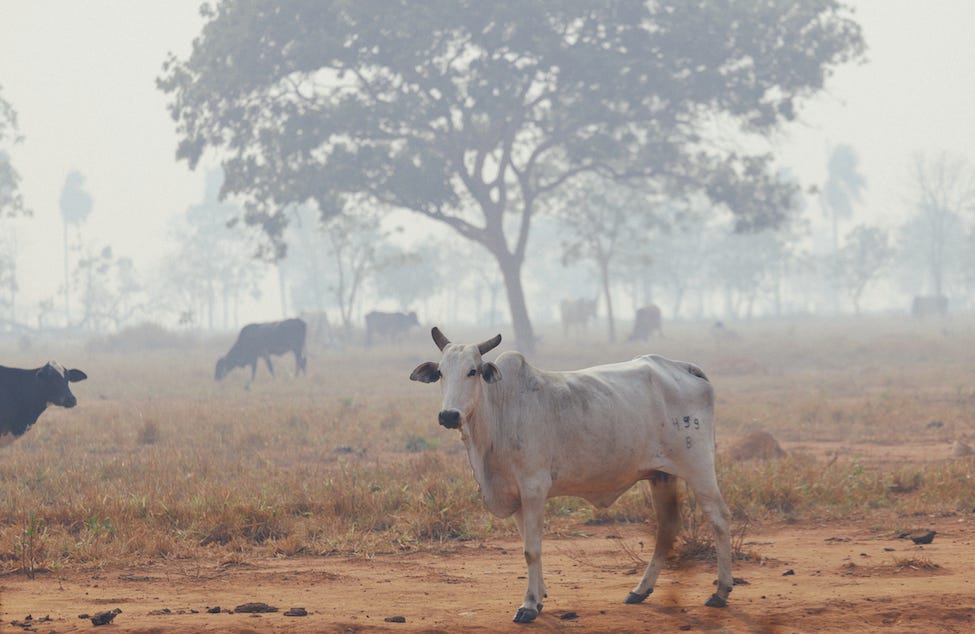
Last month the US NGO Amazon Conservation (AC) published its annual analysis of the impacts of deforestation and fires on the Amazon rainforest in 2025. What it had to say about Bolivia - which rarely attracts as much attention as Brazil etc when it comes to tropical deforestation - is worth highlighting. 20% of all Amazon primary forest loss last year was in Bolivia, according to AC, meaning that it lost more primary Amazonian forest than any other country except Brazil and therefore, “standardizing for area”, Bolivia had “the highest primary forest loss rate” of all.
Last year the UK-based Gecko Project released a film about this somewhat under-reported deforestation crisis, titled Bolivia Burning, which involved interviewing Bolivian journalist Marielle Cauthin, among many other people. I co-presented and co-produced that film for Gecko and, although the interviews were conducted in late 2024, the one with Cauthin remains worth publishing even now - partly because I found it particularly interesting and powerful, partly because of the AC analysis, and partly because of how prophetic she sounded, towards the end, in light of the political and economic crises that have engulfed Bolivia in recent months.
2024 turned out to be the worst ever year for forest fires in Bolivia - more than 12.5 million hectares impacted - and the months that Gecko was there, September and October, were two of the very worst three. Our timing could hardly have been more apposite. Here myself, Cauthin and Bolivian human rights activist and lawyer Alvaro Bozo Garcia, who co-presented and co-produced Bolivia Burning too, discuss what we had been witnessing:
ABG: Would you describe [what is happening in Bolivia right now] as ecocide?
MC: Definitely, definitely. 2019 to 2024 has been a period of premeditated ecocide. It hasn’t just been going on for a year, or a few months, but five years. It is violating Bolivian legislation like the Mother Earth Law [from 2010], which says that Nature has the right to regenerate.
DH: In one of your articles you talk about the fires being a “strategy.” Millions of hectares have been impacted, but what is causing them? Where do they come from?
MC: Farmers and cattle ranchers practice a land management technique we call “chaqueo.” That’s one, initial explanation. It has always been common in small-scale agriculture - in the dry season, from July to October, although sometimes it can start in April and continues to November, depending on the region. However, what has happened in recent years is that practice has combined with climate change and what we in the environmental movement call a “packet” of laws encouraging the use of fire. This has meant that “chaqueo” - which used to be considered more or less environmentally sustainable - has ballooned up to the magnitude that it is now.
ABG: When you talk about “agriculture” what are you referring to specifically?
MC: Commodities produced by agribusiness. Basically, soy, which is for export. Bolivia is one of the world’s top 10 soy exporters. That’s not something we should underestimate. There’s also sorghum, rice, corn and wheat, but soy is the most profitable because of international prices and export quotas.
ABG: Who is most impacted by the deforestation?
MC: The whole of Bolivia is impacted - our rights to health, water, education are impacted. Most of all, the communities and towns out in the country-side where the fires are and where people are being made ill by exposure to them, the smoke and high temperatures, as well as a severe, three year drought. We mustn’t forget the drought. There have been reports of stomach, eye and respiratory infections, which will continue spreading.
DH: Do you think you’re talking about a humanitarian crisis, in regions like the Chiquitanía and others? We’re here in Santa Cruz [de la Sierra], in the city, and we can smell the smoke. We could see it from the airport when we arrived.
MC: Definitely, definitely - and the government doesn’t want to acknowledge the extent of it. There’s no will to recognise the fundamental problem behind the fires. But in addition to it being a humanitarian crisis, it’s also an ecological crisis that runs much deeper and has potential consequences we’re only just beginning to understand - for example, on water cycles, rivers and fish, endemic species of plants and animals, communities hunting in the forest. Those communities haven’t just lost their small garden plots, but also larger areas for agro-forestry. Some have been making their living from cultivating coffee, cacao and palm fruits, which aren’t going to grow back within a year. So they’re in a kind of structural helplessness. For those who have been living off cacao. . . it’ll be five years of economic precariousness during which they’ll have to find some other way to make a living. Another consequence of all this will be increasing migration from the countryside, from the Amazon, to cities and other countries. There are already reports of people migrating to Brazil and Chile - because living conditions have become so much harder.
DH: When you say “communities”, do you mean indigenous communities?
MC: Yes, I’m mainly referring to indigenous communities. I’ve been talking to Tacana families north of La Paz, with Uchupiamona families from the Madidi National Park, with families from the Pando region who cultivate Brazil nuts, and with Mojeño families too. The pressure to migrate to the cities is extremely high and it’s becoming more and more common for people to do so for seasonal work.
ABG: Have people been migrating from communities in the Chiquitanía?
MC: I think so. I assume some people have been going to Brazil, because the border is so close. This is happening in two, three, four different parts of the country, involving different indigenous territories and communities. It’s a definite trend, but an invisible one.
DH: It would be good to talk a little about the Chiquitanía. What is it exactly and why is it so important?
MC: The Chiquitano Forest is a dry, tropical forest that acts as a transition between the Chaco and the Amazon. It’s a very important ecoregion and has a large indigenous population, and it has found itself at the centre of an agribusiness development model spanning the Atlantic Ocean to the Pacific. In Bolivia’s case the initial pressures haven’t been so much on the Chaco or the Amazon, as is happening more right now, but the Chiquitano. This agribusiness pressure - involving all of Brazil, Paraguay and Bolivia - has meant over the last 10 to 15 years very large areas of forest have been lost.
DH: It would be good to hear what you think about the international dimension to all this - that’s to say, the role of the other countries. Is that also something you know about?
MC: Exports incentivise deforestation in tropical countries. The relationship between the two is explicit and means that corporations, through their supply-chains, have a responsibility. In Bolivia there are two commodities in particular worth mentioning. One is soy, where exports remain focused on the Latin American region. The other is beef, which, since 2019, has been exported mostly to China. One big problem is that the Chinese market doesn’t have any environmental requirements - only sanitary ones - so there are no measures for traceability. On the other hand, in Latin America the requirements are weak too, so we don’t have any pressure on us from other countries, unlike in the European Union, which will be bringing in a regulation on traceability for beef, soy and other commodities.
DH: What do they do with the soy in the countries importing it? In Peru, Colombia etc. Do you know?
MC: What is exported from Bolivia is mostly what they call “cake” [“torta”], which is used as an ingredient in different products. Mainly animal feed, for poultry, cattle etc. Also, it’s used as an oil, for cooking or as ingredient in other products.
ABG: We’ve talked about some of the different actors and the negative role of the state and Bolivian legislation, but what can be done? What are the solutions?
MC: It’s obviously very complex, but one thing that environmental organisations have been asking for is an “ecological pause.” In fact, they’ve been talking about that in the Chiquitano since 2019. Agribusiness opposes any such thing because obviously it’s not in their interest.
DH: Our final question. Bolivia talks about “Mother Earth”, but in terms of deforestation it’s a world leader. Number three [now number two for the last two years]. What do you think is most strange about all this? The most shocking, most extraordinary?
MC: I think it’s the sense of betrayal. There were very loud promises made by the government and the new Constitution in 2009, so there were high expectations, a significant mandate to act on environmental issues, and strong support that could have been leveraged all these years. Bolivians who voted for that “other Bolivia” where you could have economic development as well as social and environmental development have been betrayed. We have national elections next year [ultimately won by Rodrigo Paz]. I don’t think a change of government will help change this situation, but deepen it. There’s an economic crisis running parallel to all this - Bolivia has been experiencing a very complex economic crisis for the last year. I don’t see better days coming.
ABG: Marielle, thank you very much.