
How a Shell carbon offsets project includes 'uncontacted' indigenous people’s land
Peru’s Cordillera Azul National Park marks its 25th anniversary today
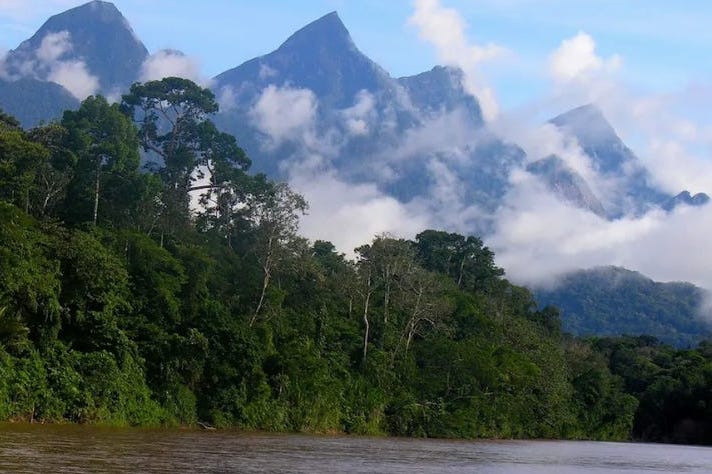
At least twice over the last five years I’ve written articles highlighting how a carbon offsets project in the Peruvian Amazon backed by oil and gas major Shell includes the territory of indigenous people living in “isolation”, widely known by the name “Kakataibo.” That project - corresponding to the Cordillera Azul National Park - has been fiercely criticised by indigenous federations, NGOs, media and others because of its obvious methodological flaws as well as the fact that the park includes so much of the indigenous Kichwa’s land, while the existence of the Kakataibo has largely been ignored.
However, what I didn’t acknowledge in those articles is that an indigenous reserve for the Kakataibo had been formally proposed, first in 1993 and then again in 1999, before the park was established. In other words, indigenous federations had wanted a significant chunk of forest to be recognised as the Kakataibo’s, as Peru’s government was obliged to do legally, but instead it became part of a park.
Those 1990s reserve proposals to protect the “uncontacted Cashibo-Cacataibo”, as they were called at the time, were both made by national indigenous federation AIDESEP. After those proposals failed to prosper, another was put forward in 2005 by Kakataibo federation FENACOCA, as it was called then, and Lima-based NGO Instituto del Bien Común (IBC). According to their 328-page report proposing the reserve, the park overlapped “approximately 196,000” hectares of Kakataibo territory, although elsewhere that same report said the park overlapped “two-thirds” and “three quarters” of the 1999-proposed reserve, which would amount to 73,000 and 82,000 hectares respectively.
Whatever the exact figures, it was obviously a large area: 73,000 hectares is roughly the same size as Singapore, 196,000 hectares bigger than Mauritius.
Margarita Vara, who worked at the IBC at the time, tells me that initially the indigenous federations were against the park overlapping the proposed reserves, but after “rigorous evaluation” it was accepted that it was the best way, at that time, to protect the Kakataibo. That was partly because of the “serious political and institutional opposition” to creating reserves, the absence of a specific law ensuring the reserves would be intangible, and the increasing advance of uncontrolled colonisation, deforestation and extractive operations.
“While it was recognised that it wasn’t the most appropriate solution for the Kakataibo’s land to become part of a conservation area like a national park, given that in the future it could block them from obtaining legal title if they decided to stop living in isolation,” says Vara, “it was also understood there was no immediate, effective alternative.”
Vara points out that the part of the park inhabited by the Kakataibo, in the south-east of the area, was made a “Strictly Protected Zone” (SPE), the most restrictive of all the zoning categories in terms of who is allowed access. It isn’t clear how big that SPE is exactly, but the map below - where it is coloured red and marked with the letters “PE”, in the south-east of the area - shows that it constitutes a very large swathe of the 1.3 million hectare park.
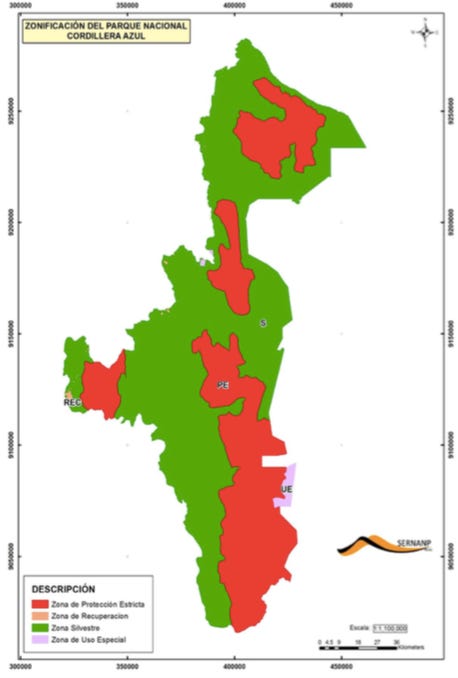
“It was difficult to convince CIMA, the NGO behind the creation of the park, and [INRENA, the state’s parks agency at the time] to admit the existence of the Kakataibo in isolation within the park,” remembers Vara’s former colleague Margarita Benavides, an IBC co-founder, “but the evidence documented by the IBC was strong and so they agreed to create a Strictly Protected Zone.”
“I think that, given the circumstances - the deforestation threats and the state’s institutional weakness - the decision to include the Kakataibo’s territory in the park meant better protection for them,” Benavides continues. “That proposal and agreement with INRENA was made by FENACOCA itself, and therefore it was seen as legitimate by other NGOs and organisations. I don’t recall any significant opposition.”
Why draw attention to this now? Partly because the park, established on 22 May 2001, celebrates its 25th anniversary today, which is also the UN’s International Biodiversity Day, and partly because the isolated Kakataibo have arguably never been in more danger. Although a reserve was finally established for them in 2021, the Inter-American Commission on Human Rights (IACHR) in Washington DC has deemed their plight so alarming that it recently issued “precautionary measures” urging Peru’s government to take immediate action to protect them, as I reported in March.
Indeed, late last month AIDESEP convened an online forum, “Kakataibo: The Right to Live without Contact.” Speakers included Marcelo Odicio, the president of FENACOKA, as it is called now, who highlighted the dangers to the Kakataibo and lambasted Peru’s government for failing to act. Some of the things he mentioned: a clandestine runway serving the cocaine trade in the reserve just eight kilometres from his community, the increasing numbers of settlers entering the reserve and growing cacao, the failure to implement a 2022-approved protection plan, and the number of Kakataibo leaders living in surrounding communities who in recent years have been murdered.
“More than 100 years ago [the isolated Kakataibo] decided to live away from the rest of us and they’ve remained like that until now, without endangering anyone and asking nothing from the state apart from being allowed to live that way,” Odicio told the forum.
All this is yet another reason why Shell’s involvement with the Cordillera Azul carbon project is so problematic. It is not just that it is methodologically flawed or that so much of the project area is Kichwa territory, as many Kichwa themselves have made clear, including by taking legal action. It is that a sizeable chunk of the project area is so incontrovertibly the territory of indigenous people in isolation that, more than 25 years ago, indigenous federations wanted to include it in an off-limits reserve. It goes without saying that, like the Kichwa, those Kakataibo weren’t consulted about the park or project, nor could they have been, and therefore they have never consented to it.
Shell hasn’t bought any credits from the project since November 2022 and is no longer promoting it on their websites like it used to, but the company remains one of its two biggest backers, along with French major TotalEnergies. Was Shell aware so much of the project area had been proposed for an indigenous reserve before the park was established? The company declined to comment.